Along one of the most storied blocks of King Street, in a residence once owned by Grammy-winning musician Darius Rucker, a newly installed custom mural is drawing attention not just for its scale, but for what it represents: a return to the hand-craft traditions that built Charleston's historic district in the first place.
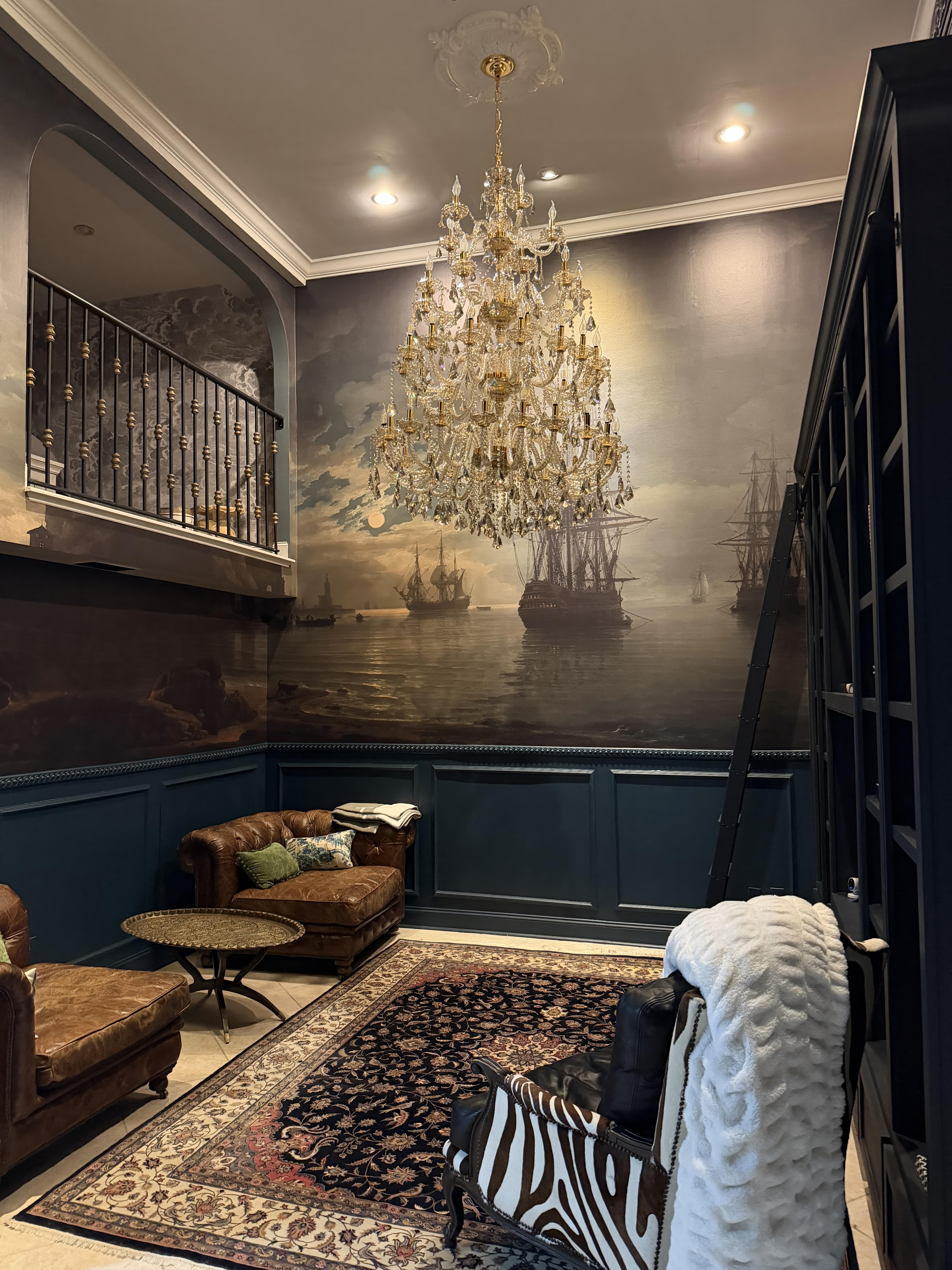
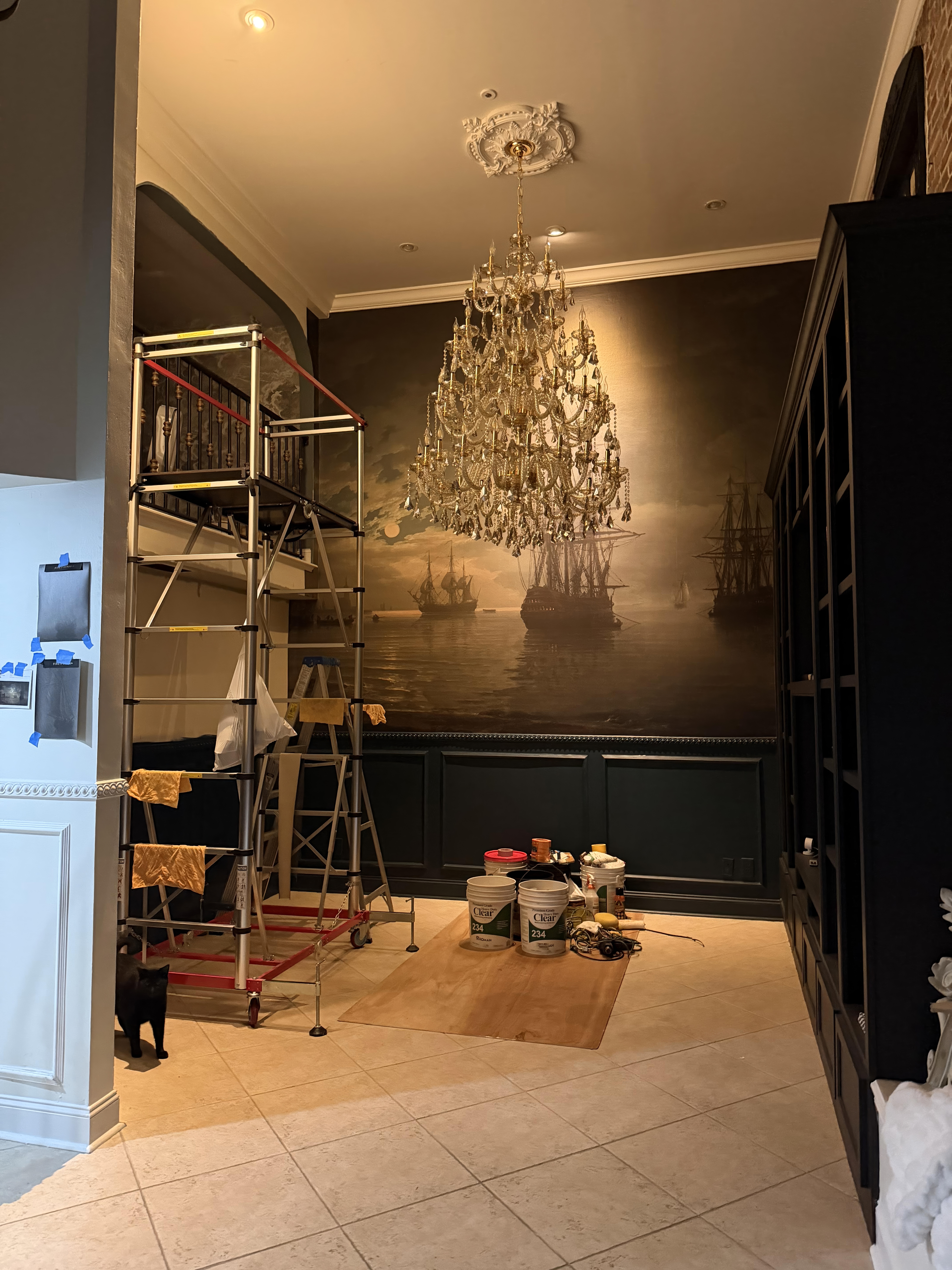
Master installers George Kazameas and his son, Constantine Kazameas, oversaw the large-scale, custom-printed canvas installation — a moody maritime scene reminiscent of ships riding at anchor in Charleston Harbor, rendered across a 15-foot custom mural from Fine & Dandy, the decorative arts house known for hand-painted, scenic wallcoverings, created specifically for the space.
The finished room pairs the mural with deep navy wainscoting painted in a Farrow & Ball hue, sourced locally through Michael Mitchell, the King Street interior design showroom, alongside an ornate plaster ceiling medallion and a multi-tier crystal chandelier — a combination the Kazameases describe as classic Charleston Regency: dramatic scale, rich color and old-world detail balanced against clean architectural lines.
"You don't get a room like this by rushing it," George Kazameas said. "I've been hanging paper for over 40 years, and the jobs that last are the ones where you respect the material and respect the wall. This mural had to feel like it had always been there."
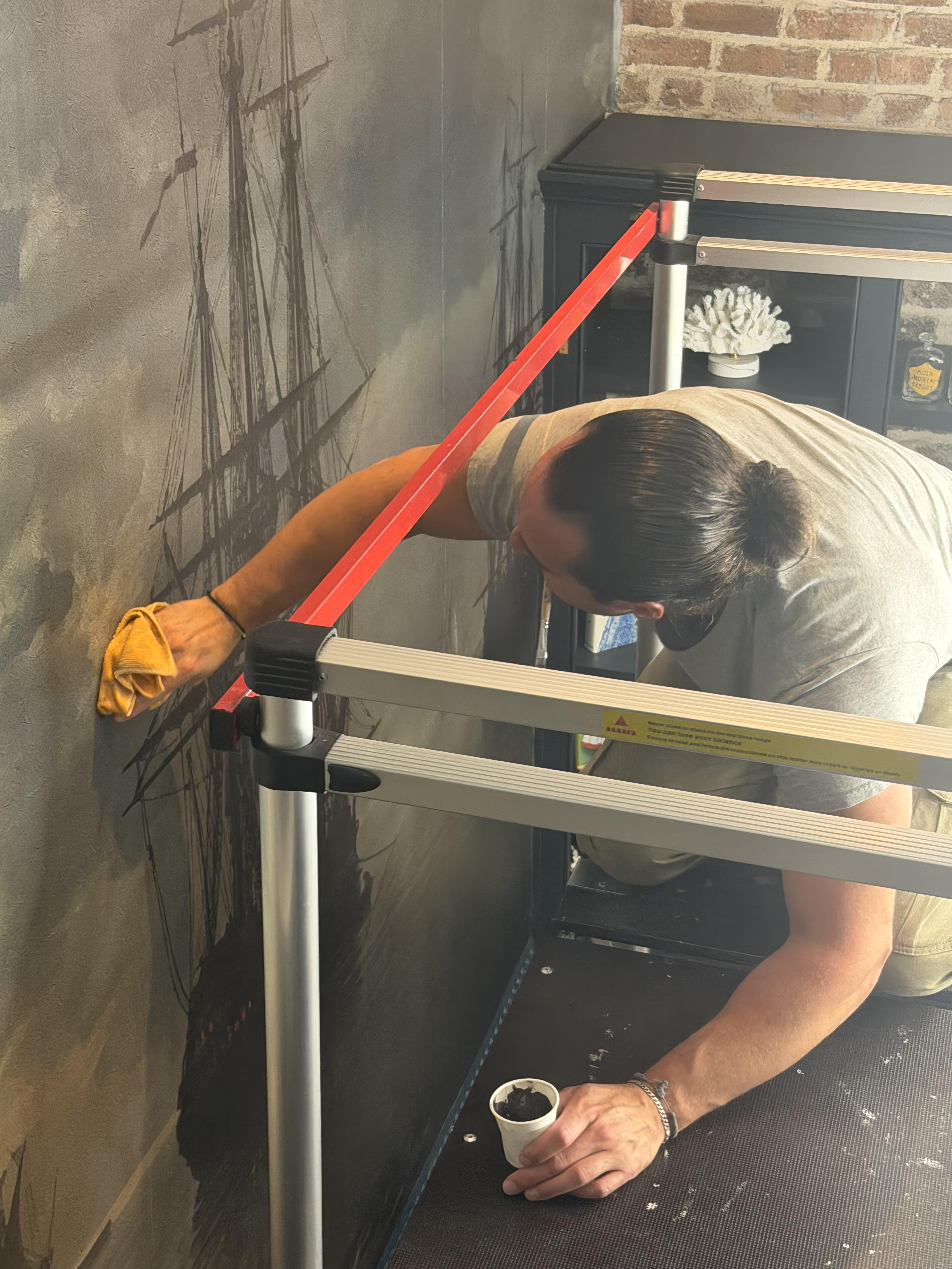
For Constantine Kazameas, who trained under his father, the King Street project was as much about craft continuity as it was about the finished wall. "My father taught me that a mural isn't wallpaper — it's a single image that has to survive being cut into panels and put back together seamlessly," Constantine Kazameas said. "On a piece this size, at 15 feet, there's no room for a seam to catch your eye. You either did it right, or everyone who walks into that room will see exactly where you didn't."
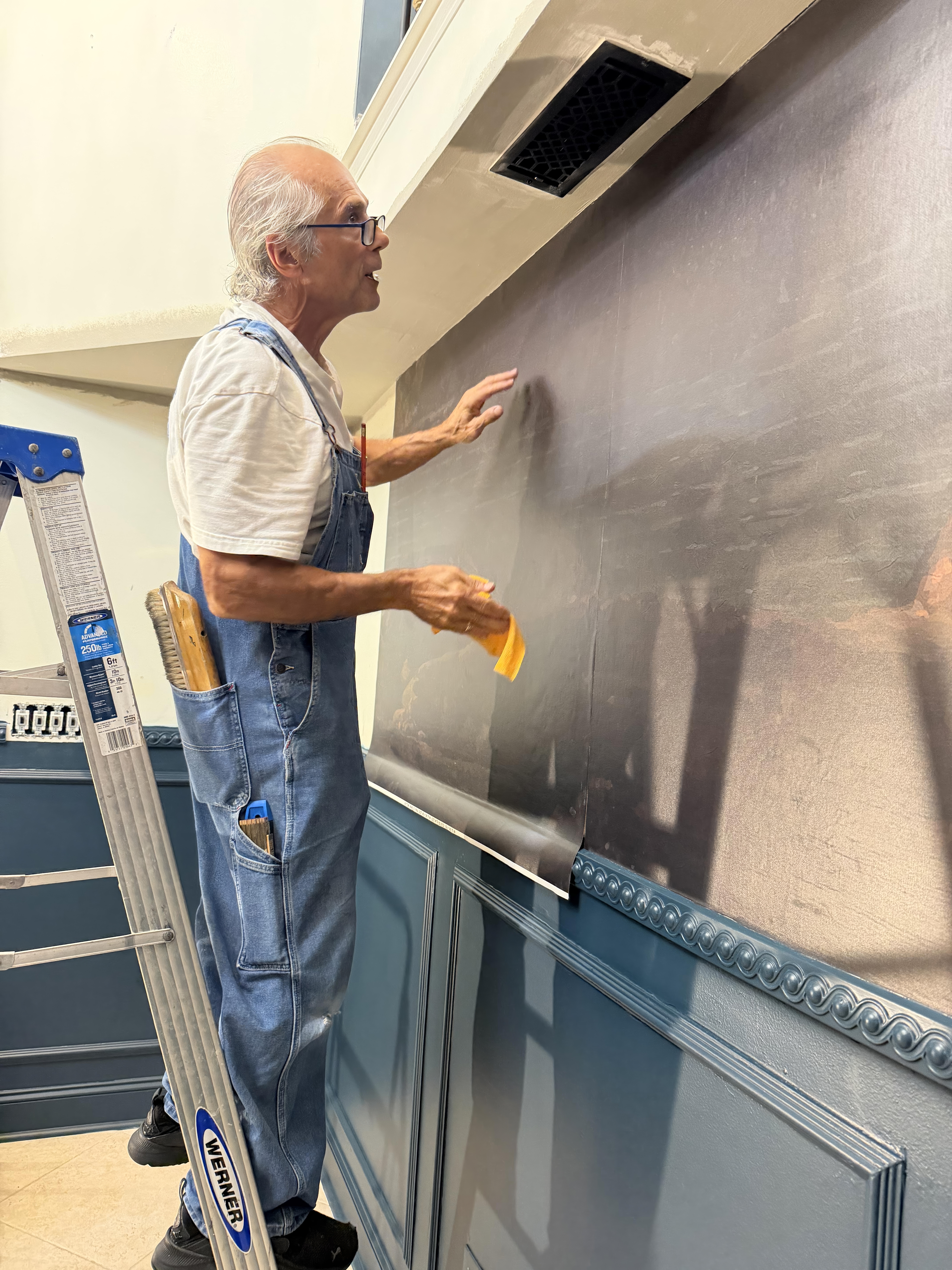
George Kazameas, who has spent more than four decades installing traditional wallcoverings in historic and luxury interiors, said the appeal of working in a Regency-influenced room like this one is the license it gives an installer to think in terms of full walls rather than isolated strips. "Forty years ago, when I started in this trade, a mural job like this was rare — most of the work was pattern-matching repeats," he said. "Now the demand is for a single, unrepeated scene that wraps a whole room. It's a return to how the great historic houses actually did it before repeat-pattern wallpaper became the standard."
The property sits at 377 King Street, in a stretch of Charleston's King Street corridor whose building stock dates largely to two major eras of development, the late 1800s and the 1940s, according to a historic building survey conducted for the South Carolina State Historic Preservation Office. King Street itself traces its name to King Charles II and has functioned as Charleston's principal commercial spine for more than two centuries, evolving through cycles of decline and reinvestment — most notably after the street was converted from one-way to two-way traffic in 1994, a change credited with accelerating the corridor's modern revitalization.
Charleston County property records show Rucker purchased the unit in November 2016 and sold it in March 2021, part of the address's broader chain of ownership on a block increasingly defined by exactly this kind of high-end residential restoration.
Designers describe the Charleston Regency aesthetic — deep jewel-toned walls, formal symmetry, gilded accents and dramatic lighting set against restrained architectural millwork — as a style that lives or dies on the quality of its wallcovering installation and the paint it's set against. The room's Farrow & Ball palette, selected through Michael Mitchell's King Street showroom, was chosen specifically to let the mural's tonal range — deep grays, dull gold lamplight, blackened harbor water — carry the room without competing with it. A mural rendered at this scale requires more than adhesive and a steady hand: substrate assessment, humidity control appropriate to a peninsula city prone to high ambient moisture, and a laser-measured layout to make sure the image's horizon line and focal points land exactly where the room's sightlines demand.
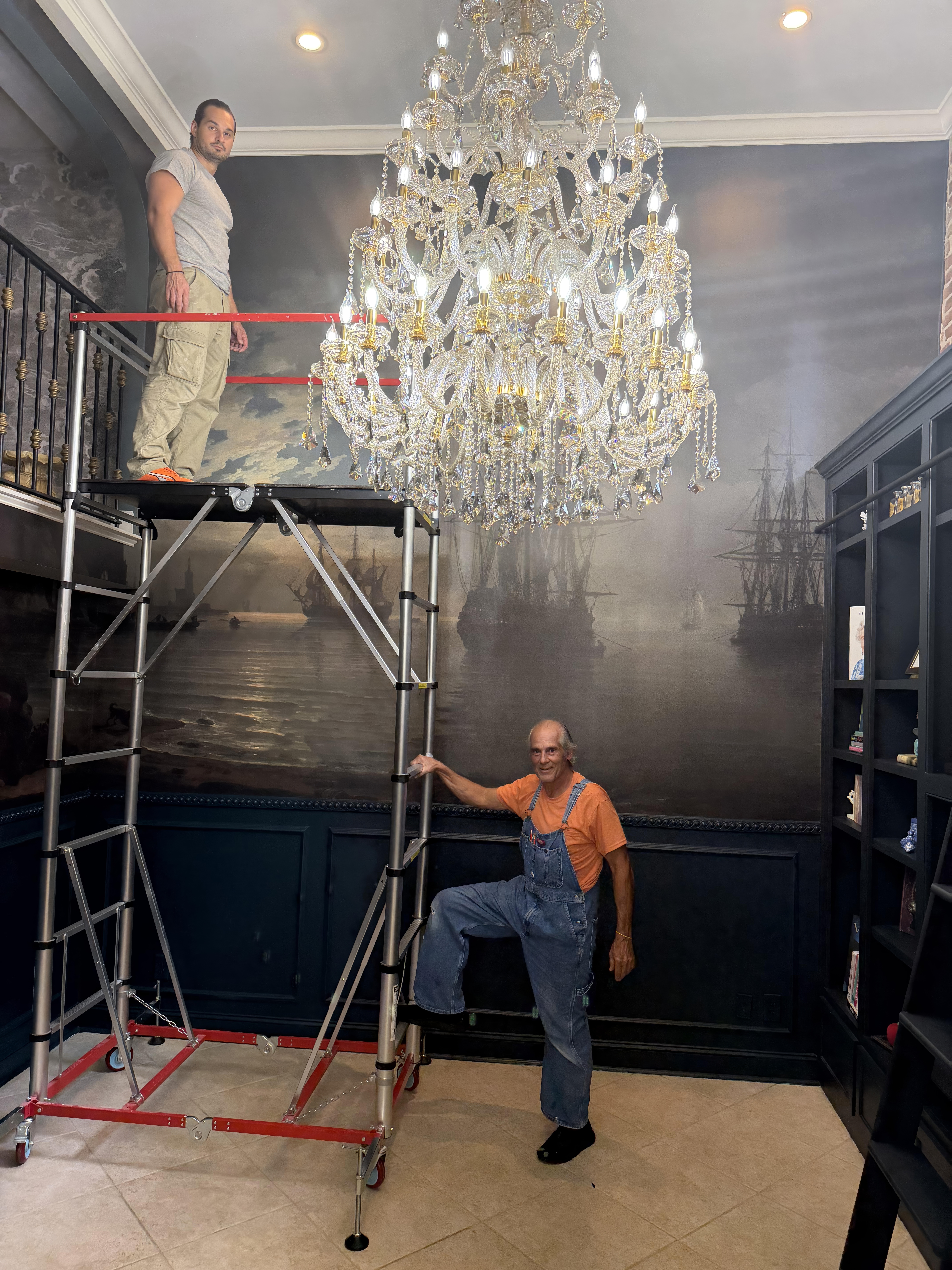
"In a city like Charleston, you're fighting humidity every single day of the install," Constantine Kazameas said. "The wall is never really finished moving. You have to build in for that, or the mural you're proud of on day one won't be the mural still on that wall in fifteen years."
For George Kazameas, the project is one more entry in a career built on the belief that a wallcovering installation is judged in decades, not days. "Forty-some years in, the compliment I still want to hear isn't 'that looks nice,'" he said. "It's somebody walking in ten years from now and asking who installed that wall — because they assume it's always been part of the house."
Charleston Decorative Arts specializes in luxury wallcoverings, historic restoration, custom murals and decorative finishes across Charleston's historic district and the broader Southeast. Mural produced by Fine & Dandy. Paint by Farrow & Ball, sourced through Michael Mitchell, Charleston.
Bring This Level of Craftsmanship to Your Project
Planning a Wallpaper Installation?
Share your wallcovering, room dimensions and project location for an installation review and quote.